Learning Lessons with Mrs. Labrasciano Home Shop Instagram Pinterest Email Image Map

Chinese New Year


Chinese New Year is a wonderful opportunity to bring engaging learning into the classroom! There is plenty of time for you to gather materials and make your lesson plans come alive for your students.  The books shown above are wonderful books to teach your students in k-2 key details about Chinese New Year.  The Dancing Dragon pulls out to show a huge 4' long Dragon Parade.  I've yet to find another book that captivates students the way that The Dancing Dragon does when you pull out the dragon pages.


Legend states that Buddha called all of the animals together to meet on the new year.  Twelve animals showed at the meeting and Buddha named a year after each one.  People born in these years are said to have the traits of the animals from their year.


During the new year, people wear red and celebrate.  One of the celebrations is the lantern festival.  People join together with family, friends and their community to celebrate the lantern festival.  There you will find beautifully decorated lanterns lit in a night parade.


 The highlight of the lantern festival is the dragon dance.  Elaborate dances are put together with dazzling costumes.  Firecrackers are lit to celebrate the new year.


Every year we read books about Chinese New Year in my class.  After we read about the new year, we make our own red lanterns and then we put on our own parade.  One student is selected to lead the parade with a paper mask that I made.  The rest of the students line up behind the leader with their arms on the person's shoulders in front of them.  I throw my red blankets over them.  They don't care that there are snowmen on them.  We dance through the classroom stepping on bubble wrap for firecracker sounds.  This is an excellent engagement activity.  Afterwards the kids are ready to read more books closely and respond to text dependent questions.  I only wish that we could teach this way every day!

Above you will find a freebie that I'm offering you to compare the Chinese New Year to the North American New Year.  (I didn't want to leave out my geographical surrounding friends!)  If you find yourself short on time and would like more lesson suggestions and materials click on the link below.


Election Day Lesson Ideas


Election Day is such an exciting time.  Build on the excitement by teaching your students about the process through fiction reading, informational reading and a mock election.


This year we are going to spend a couple of days reading "Grace For President" and "Duck For President".  When we are done we will find the central message of "Grace For President" and compare/contrast the two books the next day.


Election information has a lot of vocabulary that is new to students.  When reading an informational piece we read through the first time and circle new vocabulary.  Students are given a vocabulary spinner.  This helps the students to work with the words in a fun way.  They are asked to:  write the word, draw the word, define the word and use the word in a sentence.  If they still don't understand the word I have them make a 4-square vocabulary sheet that takes them through the same process as above, but in a more  linear fashion.  Once the vocabulary is mastered we move onto task cards.  The task cards have both lower level recall questions and higher level questions on them.  This helps to differentiate for students.


When we are done learning about the election process through reading students are walked stepped by step through acting out the process in class.  Each step has a fun activity to do in order to help all of the learners grasp the information.  This year we are voting on new genres for our classroom library and a snack to enjoy while reading those genres.  Such exciting times!  If you don't have time to put the materials together for your class click on the picture above to purchase this print and teach unit.


To get the students in a patriotic mood I like to give them simple and fun crafts to do for bellwork.  The directions for the above craft can be found by clicking on the picture.  To find the print and teach materials that I used, click on the picture. below.

Click here to find fun activities to incorporate into your classroom for Election Day, Flag Day, Independence Day, President’s Day or any patriotic day.  These fun ideas work for any primary or intermediate elementary classroom.  Your kindergarten, first, second, third, fourth or fifth grade students will love the activities shared here.  {kindergarten, first, second, third, fourth, fifth grade, homeschool}


SaveSaveSaveSave

Easy American Symbols Craft


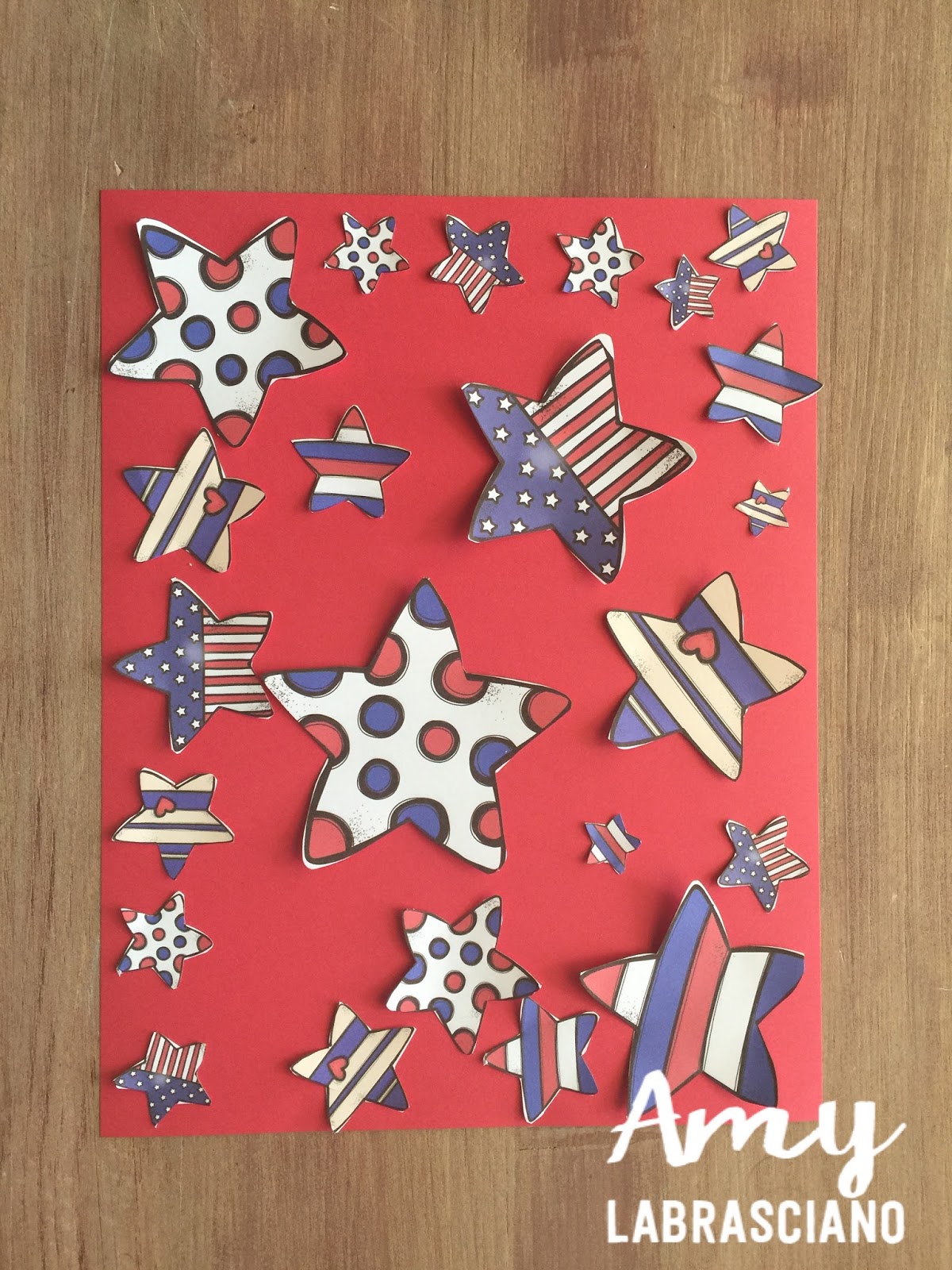
A great way to get your students to buy into their learning is to let them choose their topic to learn about.  As a closing to our symbols unit the students were able to pick one symbol that they wanted to research and become masters of it.  They were able to create this quick craft to put their work on.  Total time for rubbing is a maximum of fifteen minutes.


First cut out stars for each student to have.  You can use die cuts, volunteers or the students.  If you are putting something on top of the finished paper you do not have to have stars for the middle.  Make sure to make smaller starts for the outside so that they show past the student's work.  Consider giving students a piece of paper the same size as the one they will be rubbing so they know where to lay the stars.  For students who have fine motor skill difficulties you can put double sided tape down on the paper, under the stars.


Next give the students a plain piece of paper.  Go over different designs that they might try before hand.


If students have never done a rubbing teach them how to fill in the entire paper.


The patriotic rubbing is great enough to leave on it's own, but here you can see a symbol and writing that we glued to the paper.  I plan on having students make Veteran's Day posters for our Veteran's Day signs with this rubbing too.

Teacher Anxiety and Mindful Planning


Does your teacher to-do list ever end? I didn't think so.  A HUGE part of teacher anxiety comes from the list that seems to go on forever.  I could count on one hand the amount of times I have had nothing to do during my teaching career.  (Maybe even 1 finger.)  There's always a student(s) that needs more help, a lesson that needs to be more engaging, paperwork that the office needs, something that the principal wants, parents that need to be called, colleagues that need help, and on and on and on.  Getting caught up in this to-do list creates an all consuming anxiety in teachers.  

What if I told you it doesn't have to consume you? The older I become, the more I see my happiness comes from how I handle my life.  My life isn't perfect.  I have a house full of my own children which includes teenagers (yikes). Special needs of my own children that need to be met and often I don't know how to meet them.  My house is usually messy.  I can be found driving children in my car to their needed locations from the hours of 3-8:30 Monday through Friday.  I teach and I run a small business.  My life is what I used to call controlled chaos, but now I call it simply - life.

I've been practicing mindfulness for a couple of months now with my children.  Please stay with me here and don't think this is some crazy hippie nonsense that you can't/won't do. Practicing mindfulness started as my way of disconnecting from technology and centering my family.  Mindfulness is the quality or state of being conscious or aware of something.  It's super easy to practice and basically means you live in the present.  It can only take 30 seconds if you want it to.

One way to practice mindfulness as a teacher is to practice mindful planning.  Below you will see an example of my to-do list.  To be an effective educator, we must have plans to teach our students.  I teach ELA so those plans included shared reading, guided reading and writing.  To be healthy we must eat lunch. So my must do items every day are to make sure I have plans and eat.  If those things are done at quitting time, I'm done and go home.  If I finish those plans I go on to the "may do" list.  This list is accomplished usually 4 out of 5 days.  Did you know that you don't have to return every e-mail every day? We've been told otherwise, but I've tried it and the world didn't end.  I didn't even get in trouble because I chose the appropriate emails to be late to.  About once a week I can get to my "might do" list.  I try to plan one extra special engaging project/lesson for my students.  I usually think this project through during my carpool time (not while my kids are present) and write it out at school.  Planning like this helps you to be mindful of what's happening in the present and not focus on the "what-ifs" and "but everyone needs me!!!!!"  My notes section helps me to keep everything in perspective.  You must take care of yourself to be effective at anything.  You must put your family first because you need to raise kids who are equipped to handle the world.  There will always be more to do so don't sweat it.  Just remember that YOU ARE ENOUGH!  If you want a free blank copy of this list, you can find it by clicking on the picture below.

Below you will find a mindfulness technique that takes one minute and helps you center yourself in the present.  Try this when you feel anxiety coming on.

5-4-3-2-1
Name 5 things that you see around you.
Name 4 things that you can touch.
Name 3 things that you can hear.
Name 2 things that you can smell.
1- Now you are present in your surroundings, mindful of what is actually happening around you.


Classroom Storage Crates


I found myself in desperate need of storage for Dollar Store tubs that would store task cards and materials for my group work in class last week.  Photo boxes that craft stores sell were not deep enough to hold the materials that went along with task cards.  To fix the problem, I ordered these rulers from Amazon for 25 cents a piece and made the crates.

In order to make the crates you will need:  8 rulers, 3 pieces of wood, finishing nails, paint and wood glue.

Cut the bottom piece of wood 12" by 6".  Cut the side piece of wood 6" x 6".  After cutting them paint the wood whatever color you need.  Then use wood glue and a nail gun to put them together.  If you would like to make some for your class and you do not have electric tools you can still make the crates.  You should have the wood cut at a hardware store.  You can also nail small finishing nails through the rulers and wood with a hammer.

Below you will see what I filled my boxes with last week.  We played a Villain vs. Hero game to learn all about the power of our words.  Of course we had masks and capes to help engage us in the lesson.

Building A Classroom Culture


When it's time to go back to school we all get that deep down nervous feeling inside.  Who are our kids? Will they love us as much as we love them? Then we start thinking about one million different things that we have to do to make the perfect classroom.  What we really need to start with are lessons and conversations that build a classroom culture.  It's important to pick a few at a time and master them before moving on.  Don't feel pressured to start teaching standards on day one.  In fact, you will get more learning achieved in the long run if you build a classroom culture of respect and caring first.


Consider starting with respect first.  I spend the first few minutes of meeting students showing them how much I respect them.  I get down on their level, shake their hand, make eye contact, smile warmly and show them how much I care and respect the fact that they just walked into my classroom.    After showing students how much I respect them, I talk to them about respecting each other and me.  Showing respect for teachers and other adults is such an important skill for success. I also show respect for my students by saying "Please", "Thank you", "Excuse Me", and other manners when speaking with them. This allows me to then request and expect the same from them. When a student is speaking with me and uses an unacceptable tone or phrase, I will say "Excuse me. Would you like to try again?" This gives them the opportunity to remind themselves of how to show respect. I also respect their feelings and don't embarrass them in front of their peers. My hope is through my modeling respectful behaviors they will copy those behaviors when dealing with each other and adults. Through our previous lessons we have discussed how to be respectful when listening to adults and I continue to review those behaviors daily. 


Educating Generation Me's Children


Have you noticed a change in your classroom parents over the last few years? How about the parenting of your students?  Children born in the 80's and 90's have been classified as Generation Me.  Don't confuse the Me Generation with their siblings and children Generation Me. The Me Generation doesn't hold a candle to their children.  The Generation Me adults are characterized as having a high drive for education, being more involved in charity work than previous generations,  rejecting tradition, taking more time for themselves than previous generations, having a very healthy self-esteem, being unfiltered, shunning hard work and taking individualism to the extreme.  There are a lot of social changes that occurred in the United States since the 1970's that contributed to Generation Me.  This post won't focus on the how they came about, but rather the effects of Generation Me's parenting on today's educators.  If you are interested in the how, search Amazon for books that focus on this topic.  It's important to note that sociologists are quick to point out that there are a lot of factors that change or influence how a generation responds to different circumstances as a whole.  People of different socioeconomic status and different cultures will respond differently to social changes.  
Educators through time will tell you that every generation gets worse and worse.  We have gripes just like the educators that came before us.  Take for instance my generation, the Me Generation.  We as a whole do not like people who are different than us and carry a lot of prejudices.  We like everyone to follow the status quo.  That doesn't mean everyone in the generation subscribes to these stereotypes, it's just how we are described by others.  I feel like I have to be exceptional at making social changes in accepting others to offset my generation.  Sometimes the changes within and through generations are more drastic than others.  Over the past 10 years the dynamics between parents and teachers have changed quite a bit.  Let's review some of the changes, shall we?  In the past parents would listen to teachers and implement study habits at home.  They would spend time teaching children with hands-on educational toys and read to them.  The kids were the center of the parent's universe.  Slowly a shift began occurring with parent/child relationships.  Parents started using technology like tablets to teach their children some time ago. It was great because the apps changed as the children's needs changed.The kids loved it because it was engaging.  Parents noticed that they could get dinner together without struggling with children because the kids were on the tablets.  As the years went on, the use of technology has morphed into a form of babysitting rather than educational use.  At school educators are noticing that children have a shorter and shorter attention span every year and that ADD and ADHD are increasing quicker than we can keep up with.  Getting some students to sit through a book is next to impossible, forget asking the child to think about it and respond to their learning in writing.  This attention span has caused more behavior disruptions in the classroom than ever.


Naturally behavior disruptions are handled through the teachers communicating with the parent.  The responses that educators are getting back are shocking to them.  You have to remember that Generation Me prides themselves on unfiltered communication.  Here are some real communications between educators and parents with names changed for privacy.

Dear Parent, Bobby is having a difficult time focusing during class.  His reading has fallen slightly behind.  I am working in small groups with him to catch him up.  Here are some things that you could do at home...
Dear Teacher, You teach Bobby for 6.5 hours a day.  That's plenty of time to teach him how to read.  I do not have time to work on reading at home, that's your job.

Dear Parent, Susie said some bad words to a friend today.  When the friend said they were going to tell the teacher, Susie threatened to hurt her.  I have discussed this with Susie and she has been given consequences.  Please discuss these with Susie and help her to understand the seriousness of her actions.
Dear Teacher, So Susie was rude to someone.  Big Deal.  What consequence did the other child get? They were rude too.

An older child is sent to the office for hitting other children.  The principal calls the parent to discuss the situation.  The parent is unhappy and sends a note to the teacher.
Dear Teacher, I assume you send every child who misbehaves in class to the principal.  I need to have a conference with you immediately.  I cannot meet until after 6:30 so you will stay until I get there.

A teacher gives out skittles as a reward for hard work.  She notices that one child has worked exceptionally hard.  When she gives the child skittles, the child explains that she can't eat them.  The teacher gives her another treat that was in her purse and explains that the teacher can't normally do that, but she was so proud of her work she wanted her to have it.
The parent writes in the next day... I understand you won't normally give out a different treat for rewards.  This is unacceptable.  I have spent too much money on dental work for my child to eat the wrong treat.  You will give them a different treat when needed.
These scenarios aren't uncommon and none of them have been changed for sensationalism.  These scenarios are familiar to educators all over and some parents don't see a problem with the unfiltered communication via letter or email.  We haven't found them to be as bad in face to face communication yet.  This problem is mostly seen in younger grades like kindergarten through second grade.  As the years progress, Generation Me will start to have more children and the classroom will eventually be comprised mostly of their children.
So what effect are these interactions having on educators?  Frustration, disbelief, mental and physical exhaustion and the loss of love for educating to name just a few.  We haven't even begun to see a majority of these children in our classrooms.  You have to remember that this is just a small part of teaching.  It shouldn't take up all of a teacher's time.  Even the hardest working teachers who believe the world can be changed find themselves at a loss for ideas to fix the problem.  If the parents and students don't care, then what would make the educator want to care?  The interesting factor in this social dynamic is Generation Me is also teaching.  Now don't forget that Generation Me likes to be individual and seeks attention so they can start out as rock star teachers who make a name for themselves.  This is really beneficial to education.  The rub comes when they have to communicate with the parents who just don't care.  Even Generation Me starts to get tired of Generation Me.
There are a lot of good qualities within all the generations that are alive today.  We each have something to offer this world.  The problem we face is communicating with one another in a way that benefits the world rather than ourselves.  So what can you do to make a difference? First, decide if you are Generation Me.  If you are, take a realistic look at the positive and negative effects of your generation.  If you are a compassionate hard working individual, how can you help others in your generation to see what you see? Could you set better examples on social media and through your life?  If you are not in Generation Me, try to understand Generation Me.  What can you do to communicate with them in a way that works for everyone?
For our extreme Generation Me people who fit the stereotype exactly.  If you are a selfie loving individual who commonly thinks that they should get what they want because they deserve it, STOP it!!!! That behavior will not do anyone including yourself any good.  Consider not having children if you are in the least bit wrapped up in yourself.  If everyone puts themselves first  the world will not function, that's common sense.  Your behavior will drive educators out of the classroom sooner than later and you won't like what replaces them.  Go out into the world today and do something selfless just because you can.  Leave the world better than when you found it.