Learning Lessons with Mrs. Labrasciano Home Shop Instagram Pinterest Email Image Map
Showing posts with label native American. Show all posts

Teaching Elementary Students About Native American History

Click here to learn about teaching elementary students about Native American History.  You'll learn how to combine your Native American social studies unit together with reading and writing in order to fit everything into your year. Common core standards are included in the post to help you align your curriculum.  Perfect for 2nd grade and 3rd grade! {2nd, 3rd, homeschool} #nativeamerican #socialstudies


Do you have the honor of teaching your students about the Native American Nations?  It's always one of my students' favorite social studies units.  Along with the honor of teaching students about indigenous people also comes a great responsibility.  It's very important as educators that we are always in touch with our bias and misconceptions about different cultures when we plan and teach. In this post we will discuss what and how I teach about indigenous people of the United States.

Here are a few things to consider while lesson planning:

1.  Use terms like indigenous people, First Americans, Native Americans.
2.  Indigenous people span a large variety of nations and areas.  Discuss and explain to students that they are all vastly different and cannot be grouped together.
3. DON'T dress your students up! It's not o.k. and we should all know better by now.
4.  Don't speak of Native Americans in exclusively past tense form.  We always discuss our local communities and some examples of how Native Americans in the area currently live.  If we have any families in the class that come from the culture of topic, they are invited in to teach us about their culture.  This is a practice we use when learning about all cultures.

First American nations are vastly different and diverse.  Due to this, my Native American Unit is my longest social studies unit of the year.  We touch on this unit during Thanksgiving when we read and learn about the true story of Thanksgiving.  We discuss this during our immigration unit when we learn who the first immigrants to the United States were and we have a month long unit in the spring when we learn about some of the different regions of indigenous nations.

In order to fit this unit into our packed schedule, we align the unit to our reading and writing standards.  I live in Florida which has adapted common core standards.

For shared reading we spend about two weeks reading about some of the different North American regions.  I align the lessons to these standards:

STANDARDS
CCSS.ELA-LITERACY.RI.2.1
Ask and answer such questions as who, what, where, when, why, and how to demonstrate understanding of key details in a text.
CCSS.ELA-LITERACY.RI.2.2
Identify the main topic of a multiparagraph text as well as the focus of specific paragraphs within the text.
CCSS.ELA-LITERACY.RI.2.3
Describe the connection between a series of historical events, scientific ideas or concepts, or steps in technical procedures in a text.
In writing we spend an entire month creating informative pieces.  I align the lessons to these standards:
CCSS.ELA-LITERACY.W.2.2
Write informative/explanatory texts in which they introduce a topic, use facts and definitions to develop points, and provide a concluding statement or section.
CCSS.ELA-LITERACY.W.2.5
With guidance and support from adults and peers, focus on a topic and strengthen writing as needed by revising and editing.
CCSS.ELA-LITERACY.W.2.7
Participate in shared research and writing projects (e.g., read a number of books on a single topic to produce a report; record science observations).
Click here to learn about teaching elementary students about Native American History.  You'll learn how to combine your Native American social studies unit together with reading and writing in order to fit everything into your year. Common core standards are included in the post to help you align your curriculum.  Perfect for 2nd grade and 3rd grade!


The main regions that we focus on are:
REGIONS
1. Northwest
2. Northeast (Eastern Woodlands)
3. Southwest
4. Southeast
5. Plains

We discuss the areas and the natural resources that each habitat had to offer the people who lived in the region.  We learn the names of different groups who resided in the area.  We also learn about one nation from the region.

While learning about the natural resources we focus on these:
AREAS TO COVER
1.  Food
2.  Clothing
3.  Shelter
4.  Practices
5.  Art
Click here to learn about teaching elementary students about Native American History.  You'll learn how to combine your Native American social studies unit together with reading and writing in order to fit everything into your year. Common core standards are included in the post to help you align your curriculum.  Perfect for 2nd grade and 3rd grade!

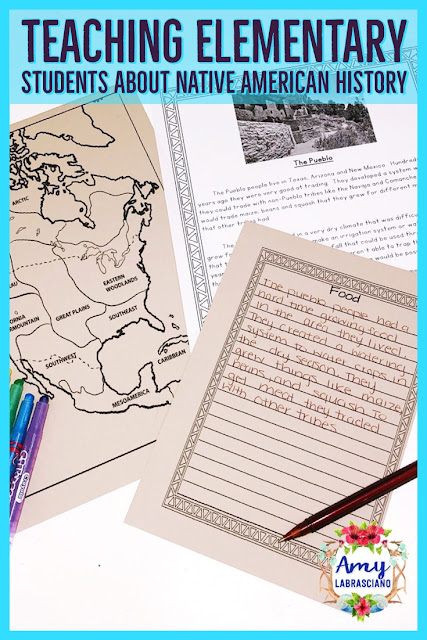
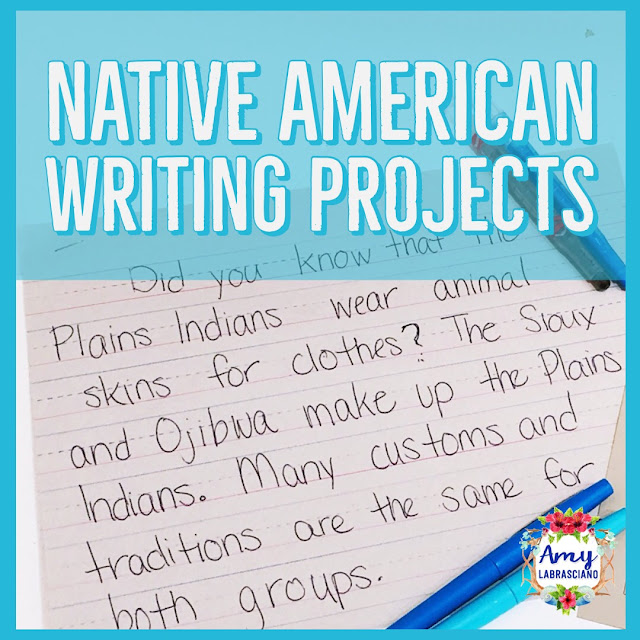
While reading and writing, students gather information in order to answer writing prompts that I've given them so that they can compose a book from the region of their choice.  In the book, all on level and above level students write 7 paragraphs with support from me.  The task is shortened for below level students according to their needs.  The writing pieces  have the introduction, the five areas mentioned above, each with it's own paragraph and the conclusion.  Depending on the student, some of these paragraphs are shorter than others.  We start the reading unit one week before we start the writing unit so that students have had a chance to learn a little about the different areas and can then make their choice of what to write about.  Each student is given the opportunity to choose  their region of choice because it makes them more invested in the task and they take it more serious.

Click here to learn about teaching elementary students about Native American History.  You'll learn how to combine your Native American social studies unit together with reading and writing in order to fit everything into your year. Common core standards are included in the post to help you align your curriculum.  Perfect for 2nd grade and 3rd grade!

Click here to learn about teaching elementary students about Native American History.  You'll learn how to combine your Native American social studies unit together with reading and writing in order to fit everything into your year. Common core standards are included in the post to help you align your curriculum.  Perfect for 2nd grade and 3rd grade!
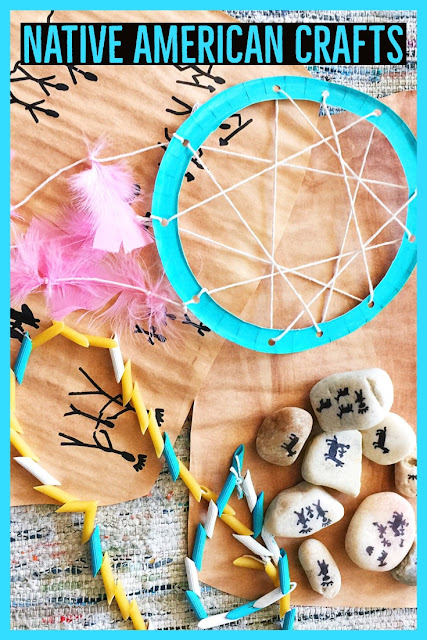
When students are done with their writing piece they get to choose a piece of art from their region to create.  They must learn about the significance of the piece that they are making before they get to make it.  Because we are on a strict budget, we use what materials we have on hand. I will show you the art below with the region.  Just click on the pictures when you are done reading this post to go to a more detailed post about the art work.

Southwest Rock Drawings
Click here to learn about teaching elementary students about Native American History.  You'll learn how to combine your Native American social studies unit together with reading and writing in order to fit everything into your year. Common core standards are included in the post to help you align your curriculum.  Perfect for 2nd grade and 3rd grade!


Plains & Southeast Animal Hides
Click here to learn about teaching elementary students about Native American History.  You'll learn how to combine your Native American social studies unit together with reading and writing in order to fit everything into your year. Common core standards are included in the post to help you align your curriculum.  Perfect for 2nd grade and 3rd grade!

Northwest Dream Catcher
Click here to learn about teaching elementary students about Native American History.  You'll learn how to combine your Native American social studies unit together with reading and writing in order to fit everything into your year. Common core standards are included in the post to help you align your curriculum.  Perfect for 2nd grade and 3rd grade!

Northeast Jewelry
Click here to learn about teaching elementary students about Native American History.  You'll learn how to combine your Native American social studies unit together with reading and writing in order to fit everything into your year. Common core standards are included in the post to help you align your curriculum.  Perfect for 2nd grade and 3rd grade!

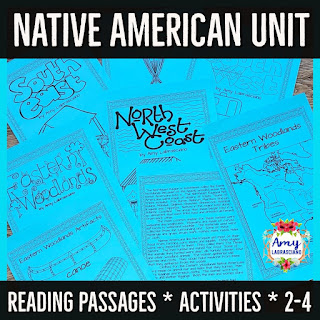
This social studies unit takes a lot of resources to teach.  In order to meet all of the students' needs, I wrote two different social studies units to teach with.  I have a Native American Unit that includes passages from each region listed above, writing books and task cards.  The passages each focus on all the information listed in the post.  I also have a unit on specific Native American nations.  The nations are: Cherokee, Sioux, Wampanoag, Pueblo and Comanche. You can find these units by clicking below.  Feel free to leave any comments with lessons that worked for your class.  We always learn and teach better together.  Feel free to email me any questions that you may have. Happy teaching!
Click here to learn about teaching elementary students about Native American History.  You'll learn how to combine your Native American social studies unit together with reading and writing in order to fit everything into your year. Common core standards are included in the post to help you align your curriculum.  Perfect for 2nd grade and 3rd grade!

Social Studies: Native American Projects in the Classroom


If you're like me, teaching social studies is near and dear to your heart.  In this post you will find a few ideas about creating meaningful projects in the classroom to help your students understand some Native American history.  When creating the projects I've kept in mind time, money and skill level.  


Native Americans created pictures on rocks to record their tribal history.  These pictures could be done by drawing, painting or carving into the rock.  The southwestern United States contains the largest concentration of rocks used by Native Americans to record their tribal history.  You might see pictures like buffalo, horses, deer or hunting on these rocks.  


When teaching students about this tradition you could do a couple of projects that are quick and meaningful.  Consider giving your students rocks with a flat surface and asking them to record part of their history on the rock.  That may contain a car for transportation, food or something important to their everyday life.  You could also have them research cave drawing and recreate a picture on the rock and explain it in writing.  The rocks above were drawn on with sharpie marker and it took about 2 minutes.


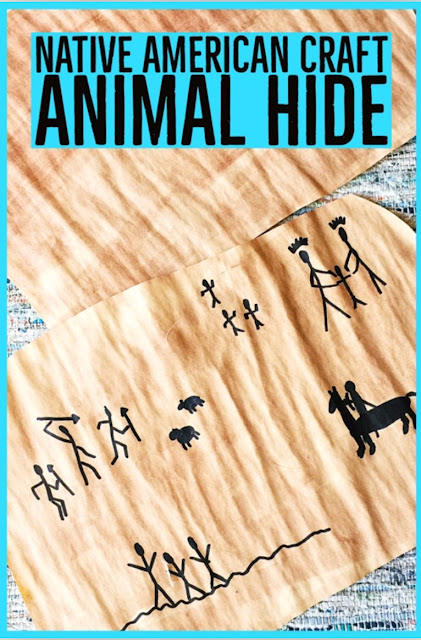
Animal hides have been used by Native Americans for several purposeful reasons.  They were used for practical reasons like clothing, travel and shelter.   Hides were also used for spiritual reasons like healing the sick and promoting healthy moms.  Some tribes recorded their history on the hides with paintings.

When teaching students about this tradition you could give them brown paper bags, construction paper or dye paper a brown hue.  Have students research the history behind hides and recreate something using the paper as a hide.  The paper above was stained with water and a bit of brown paint in the water. It took 2 minutes to paint it.  You could allow it to dry over night. It took 5 minutes to create the drawings.


The popular dreamcatcher was originally created by the Ojibwe.  It was created to catch everything bad or evil and protect infants.  The dreamcatcher was hung on the infant's cradle or carrier.  Spiritual or sacred items could be used when weaving the web in the dreamcatcher.  Such items might be feathers, beads, bones and hide.

Consider having students research dream catchers and creating one of their own with paper plates, string and other items that you have in the classroom.  The design intricacy could be chosen based on the age of your students.  I numbered the holes for students which allowed them to string it in about 10 minutes.  Click here to find a pattern for the holes and numbers.


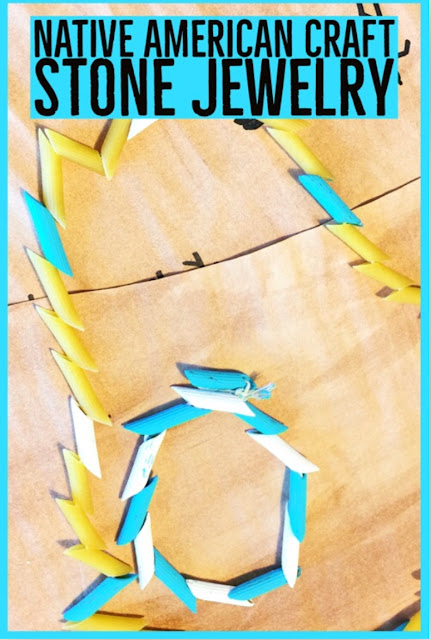
Native American jewelry has long been admired for it's beauty and meaning.  This jewelry can be include necklaces, earrings, bracelets, rings, pins, belts, etc.  While jewelry is different and specific to each region and tribe, many times designs are borrowed and used across areas.

Some materials used to create necklaces were bone and stone.  Have your students research the significance behind this jewelry and create a necklace of their own.  Consider having your students paint pasta like bones/stones and creating a necklace of their own.  We dropped a little bit of paint in a paper Dixie cup and had students swish the pasta around.  After the paint we laid the pasta out to dry.


If you are in need of reading passages, lessons and materials to teach your students about the different Native American Regions check out the unit below by clicking on the picture.


Find another detailed post about teaching Native American History here:
Click here to learn about teaching elementary students about Native American History.  You'll learn how to combine your Native American social studies unit together with reading and writing in order to fit everything into your year. Common core standards are included in the post to help you align your curriculum.  Perfect for 2nd grade and 3rd grade writing curriculum!


Must Have Social Studies Books for 2nd and 3rd Grade


One of the largest problems that I have to solve each year in my classroom is how to teach social studies.  We are given very  little resources for social studies and no time in our schedule!!!! How about you? Last year I decided to really focus on how to integrate social studies into our day, teach the students the best lessons available and appease the powers that be as best I could.  The first task was to find books that I could build a social studies library with.  While I can't afford every book in this post, I tried to focus on a few key ones and check the rest out from the library when needed.

 If one can be addicted to books then I'm certainly addicted to True Books.  They are perfect for 2nd and 3rd grade.  The students are drawn to the vivid photographs making them a hit for everyone.  I purchased one from every native American region for my students to read.  If you are interested, try to purchase them used on Amazon.  Prime members get some used books shipped for free.  Each book ran around $4 with library binding. That's right library binding.  They are sure to last a long time.  Most of them look brand new.  If they didn't look brand new they had just a bit of wear.  Only having one book for students is an issue.  To overcome this we split the class into groups and have each one study a tribe.  We then came together and debrief with classroom conversation and show projects that we have worked on.


Samuel Eaton and Sarah Morton are always a hit with students.  The vivid photographs capture their attention.  "The Thirteen Colonies"s is a great book, but not as captivating as Samuel and Sarah. I haven't  purchased "Land of the Pilgrims' Pride" with Ellis the elephant, but it's next on my list.  If you have it would you please leave a comment on how you like it?


"The Name Jar" and "Grandfather's Journey" are both great books that tell stories of immigration.  I have a feeling I'll be collecting the entire collection of Ellis the Elephant books this year.


"How to Behave and Why" is a fabulous book that explains why we follow rules.  It's not fancy, but it does a great job of explaining the content.  The biography books by Meltzer do a nice job of showing contributions by exceptional citizens.  There is a whole series so you could pick one near and dear to you.


Finding the perfect book on economics for children is an arduous task!!!! The books on the bottom row have the exact content to teach students.  They are written on a lower level, but sometimes it's nice to have a quick read that does the job.


Have you found a book on mapping that you can't live without?  This is a tough subject to write on.  I used "Mapping Penny's World" and "Follow That Map!" last year.  They got the job done.


If I had to have one book with symbols, "America" is a good one.  It has a lot of nice illustrations that show symbols.


It's hard to suggest culture books when there are so many. I try to focus on informational text that engages students and explains the basics of the culture.  We didn't have enough time in our school year to study a meaningful amount of cultures last year so we came up with a plan.  My grade level held a culture fair.  Each class studied a different country.  The students then got to rotate through the classes to learn about different ones.  It was a great way to increase learning and engagement within a short time span.

Aside from finding books to use I also had to write lessons that ran about 20 minutes each.  We needed to have materials that were hands-on, engaging and explicit.  I worked all year to develop lesson suggestions and materials that fit my student's needs and helped them to master the content.  If you don't have time to do this, you can click on the link below to visit my store and materials.