Learning Lessons with Mrs. Labrasciano Home Shop Instagram Pinterest Email Image Map
Showing posts with label lesson plans. Show all posts

Teaching Elementary Students About Native American History

Click here to learn about teaching elementary students about Native American History.  You'll learn how to combine your Native American social studies unit together with reading and writing in order to fit everything into your year. Common core standards are included in the post to help you align your curriculum.  Perfect for 2nd grade and 3rd grade! {2nd, 3rd, homeschool} #nativeamerican #socialstudies


Do you have the honor of teaching your students about the Native American Nations?  It's always one of my students' favorite social studies units.  Along with the honor of teaching students about indigenous people also comes a great responsibility.  It's very important as educators that we are always in touch with our bias and misconceptions about different cultures when we plan and teach. In this post we will discuss what and how I teach about indigenous people of the United States.

Here are a few things to consider while lesson planning:

1.  Use terms like indigenous people, First Americans, Native Americans.
2.  Indigenous people span a large variety of nations and areas.  Discuss and explain to students that they are all vastly different and cannot be grouped together.
3. DON'T dress your students up! It's not o.k. and we should all know better by now.
4.  Don't speak of Native Americans in exclusively past tense form.  We always discuss our local communities and some examples of how Native Americans in the area currently live.  If we have any families in the class that come from the culture of topic, they are invited in to teach us about their culture.  This is a practice we use when learning about all cultures.

First American nations are vastly different and diverse.  Due to this, my Native American Unit is my longest social studies unit of the year.  We touch on this unit during Thanksgiving when we read and learn about the true story of Thanksgiving.  We discuss this during our immigration unit when we learn who the first immigrants to the United States were and we have a month long unit in the spring when we learn about some of the different regions of indigenous nations.

In order to fit this unit into our packed schedule, we align the unit to our reading and writing standards.  I live in Florida which has adapted common core standards.

For shared reading we spend about two weeks reading about some of the different North American regions.  I align the lessons to these standards:

STANDARDS
CCSS.ELA-LITERACY.RI.2.1
Ask and answer such questions as who, what, where, when, why, and how to demonstrate understanding of key details in a text.
CCSS.ELA-LITERACY.RI.2.2
Identify the main topic of a multiparagraph text as well as the focus of specific paragraphs within the text.
CCSS.ELA-LITERACY.RI.2.3
Describe the connection between a series of historical events, scientific ideas or concepts, or steps in technical procedures in a text.
In writing we spend an entire month creating informative pieces.  I align the lessons to these standards:
CCSS.ELA-LITERACY.W.2.2
Write informative/explanatory texts in which they introduce a topic, use facts and definitions to develop points, and provide a concluding statement or section.
CCSS.ELA-LITERACY.W.2.5
With guidance and support from adults and peers, focus on a topic and strengthen writing as needed by revising and editing.
CCSS.ELA-LITERACY.W.2.7
Participate in shared research and writing projects (e.g., read a number of books on a single topic to produce a report; record science observations).
Click here to learn about teaching elementary students about Native American History.  You'll learn how to combine your Native American social studies unit together with reading and writing in order to fit everything into your year. Common core standards are included in the post to help you align your curriculum.  Perfect for 2nd grade and 3rd grade!


The main regions that we focus on are:
REGIONS
1. Northwest
2. Northeast (Eastern Woodlands)
3. Southwest
4. Southeast
5. Plains

We discuss the areas and the natural resources that each habitat had to offer the people who lived in the region.  We learn the names of different groups who resided in the area.  We also learn about one nation from the region.

While learning about the natural resources we focus on these:
AREAS TO COVER
1.  Food
2.  Clothing
3.  Shelter
4.  Practices
5.  Art
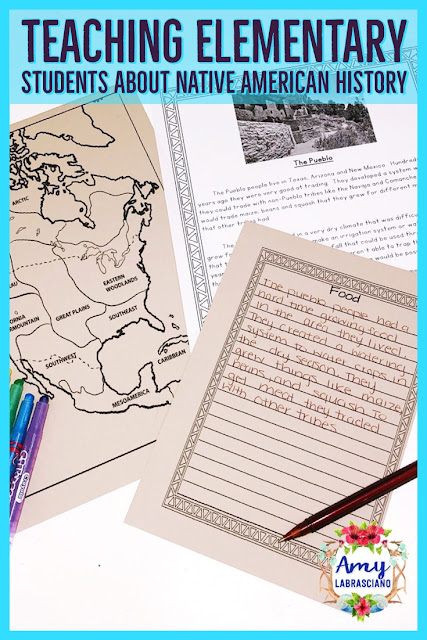
Click here to learn about teaching elementary students about Native American History.  You'll learn how to combine your Native American social studies unit together with reading and writing in order to fit everything into your year. Common core standards are included in the post to help you align your curriculum.  Perfect for 2nd grade and 3rd grade!

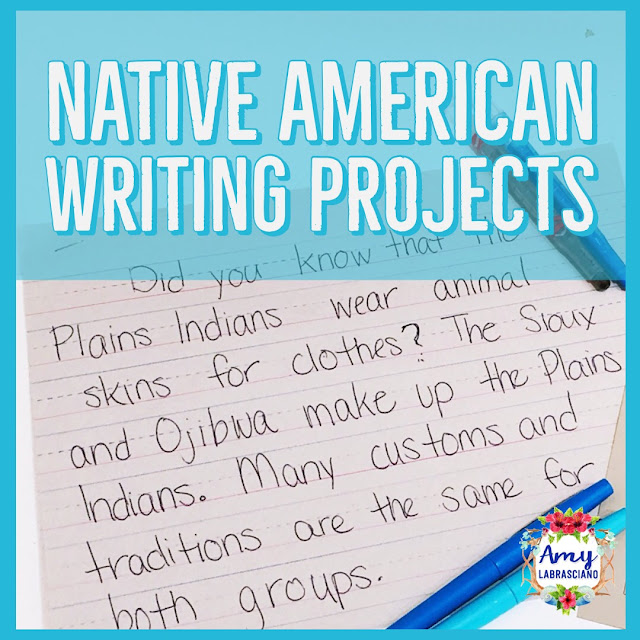
While reading and writing, students gather information in order to answer writing prompts that I've given them so that they can compose a book from the region of their choice.  In the book, all on level and above level students write 7 paragraphs with support from me.  The task is shortened for below level students according to their needs.  The writing pieces  have the introduction, the five areas mentioned above, each with it's own paragraph and the conclusion.  Depending on the student, some of these paragraphs are shorter than others.  We start the reading unit one week before we start the writing unit so that students have had a chance to learn a little about the different areas and can then make their choice of what to write about.  Each student is given the opportunity to choose  their region of choice because it makes them more invested in the task and they take it more serious.

Click here to learn about teaching elementary students about Native American History.  You'll learn how to combine your Native American social studies unit together with reading and writing in order to fit everything into your year. Common core standards are included in the post to help you align your curriculum.  Perfect for 2nd grade and 3rd grade!

Click here to learn about teaching elementary students about Native American History.  You'll learn how to combine your Native American social studies unit together with reading and writing in order to fit everything into your year. Common core standards are included in the post to help you align your curriculum.  Perfect for 2nd grade and 3rd grade!
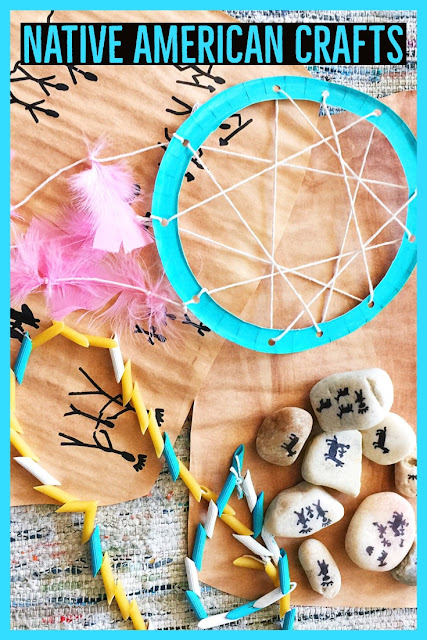
When students are done with their writing piece they get to choose a piece of art from their region to create.  They must learn about the significance of the piece that they are making before they get to make it.  Because we are on a strict budget, we use what materials we have on hand. I will show you the art below with the region.  Just click on the pictures when you are done reading this post to go to a more detailed post about the art work.

Southwest Rock Drawings
Click here to learn about teaching elementary students about Native American History.  You'll learn how to combine your Native American social studies unit together with reading and writing in order to fit everything into your year. Common core standards are included in the post to help you align your curriculum.  Perfect for 2nd grade and 3rd grade!


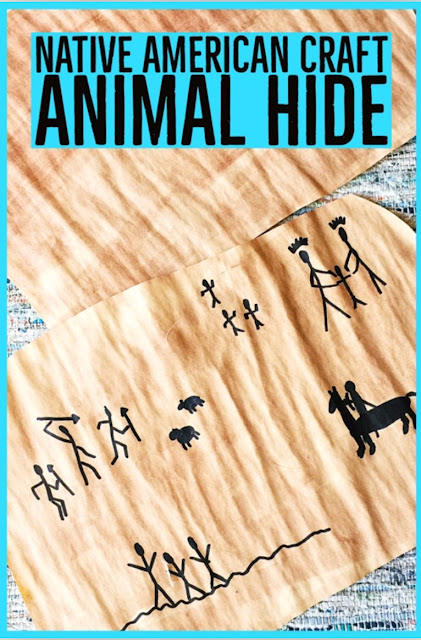
Plains & Southeast Animal Hides
Click here to learn about teaching elementary students about Native American History.  You'll learn how to combine your Native American social studies unit together with reading and writing in order to fit everything into your year. Common core standards are included in the post to help you align your curriculum.  Perfect for 2nd grade and 3rd grade!

Northwest Dream Catcher
Click here to learn about teaching elementary students about Native American History.  You'll learn how to combine your Native American social studies unit together with reading and writing in order to fit everything into your year. Common core standards are included in the post to help you align your curriculum.  Perfect for 2nd grade and 3rd grade!

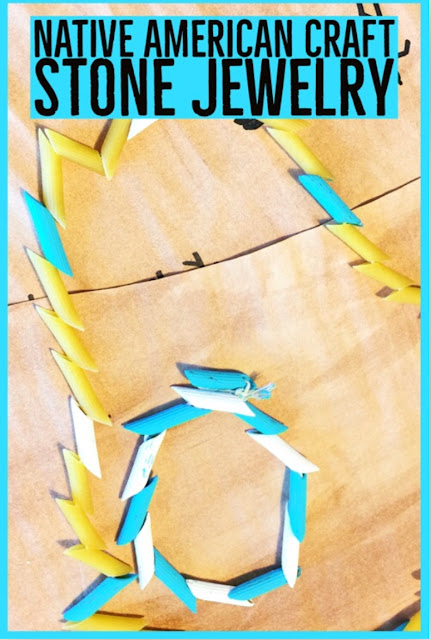
Northeast Jewelry
Click here to learn about teaching elementary students about Native American History.  You'll learn how to combine your Native American social studies unit together with reading and writing in order to fit everything into your year. Common core standards are included in the post to help you align your curriculum.  Perfect for 2nd grade and 3rd grade!

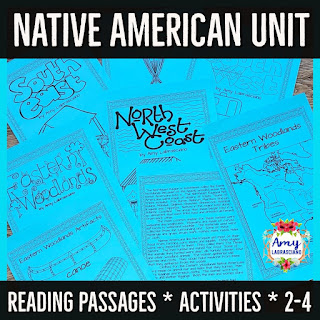
This social studies unit takes a lot of resources to teach.  In order to meet all of the students' needs, I wrote two different social studies units to teach with.  I have a Native American Unit that includes passages from each region listed above, writing books and task cards.  The passages each focus on all the information listed in the post.  I also have a unit on specific Native American nations.  The nations are: Cherokee, Sioux, Wampanoag, Pueblo and Comanche. You can find these units by clicking below.  Feel free to leave any comments with lessons that worked for your class.  We always learn and teach better together.  Feel free to email me any questions that you may have. Happy teaching!
Click here to learn about teaching elementary students about Native American History.  You'll learn how to combine your Native American social studies unit together with reading and writing in order to fit everything into your year. Common core standards are included in the post to help you align your curriculum.  Perfect for 2nd grade and 3rd grade!

Lesson Planning Made Simple

Click here to find ideas and strategies for making lesson planning simple.  You'll see how to break down the process from a yearly outline to a daily lesson plan.  Resources and ideas for making your busy life less hectic when it comes to lesson planning are included.  There is even a year's worth of 2nd grade lesson outlines included for free.  {lesson plans, lesson outlines, 2nd, 3rd, homeschool, second, third}

Does lesson planning overwhelm you? Hopefully I can help you out with a few strategies and ideas that will simplify the process. Read below.

Click here to find ideas and strategies for making lesson planning simple.  You'll see how to break down the process from a yearly outline to a daily lesson plan.  Resources and ideas for making your busy life less hectic when it comes to lesson planning are included.  There is even a year's worth of 2nd grade lesson outlines included for free.  {lesson plans, lesson outlines, 2nd, 3rd, homeschool, second, third}


First things first.  You need to know what it is you are accountable for teaching. Make sure to have your standards printed.  Most states have either adopted common core or they have standards that are almost the same as common core but they changed the name so parents would stop complaining.  Whomever thought of that was a genius because it worked!

Before we go on, it's important for me to note that none of the resources listed here are affiliates or pay me to discuss them.  I've just used them for years in my classroom and I think they might have something you might be interested in.  The next thing I can't live without is my Common Core Companion.  It comes in handy when I need to differentiate, find questions to ask students or just need to understand what the authors had in mind. Most questions that I receive about lessons come from teachers who think the standard means something totally different than someone else because their district trained them differently or so forth.  It's a no brainer when you pull out a resource that explains five different ways exactly what the common core author's had in mind when they wrote it.

Click here to find ideas and strategies for making lesson planning simple.  You'll see how to break down the process from a yearly outline to a daily lesson plan.  Resources and ideas for making your busy life less hectic when it comes to lesson planning are included.  There is even a year's worth of 2nd grade lesson outlines included for free.  {lesson plans, lesson outlines, 2nd, 3rd, homeschool, second, third}


The next resource I use is my teacher planner from A Modern Teacher.  This helps me to sketch out a quick yearly plans as well as detailed plans.  There is a lot of value and research that supports thematic teaching.  I use the planner to plug in what themes I want as well as when to teach standards. It's nice that you can use almost any topic to teach standards in reading and writing.

Click here to find ideas and strategies for making lesson planning simple.  You'll see how to break down the process from a yearly outline to a daily lesson plan.  Resources and ideas for making your busy life less hectic when it comes to lesson planning are included.  There is even a year's worth of 2nd grade lesson outlines included for free.  {lesson plans, lesson outlines, 2nd, 3rd, homeschool, second, third}

When it comes to teaching standards look them over and start with the ones the students had more access to in the year prior or that aren't as difficult.  You can check the Common Core Companion to see the standards from the year before.  If you aren't sure where to start, seek the help of a coworker.  In one hour you could sketch out the whole year.  Your goal isn't to have detailed plans, but rather an overview that makes sure you will teach the standards to mastery. I like to start the year with Asking and Answering Questions in both literature and informational. It's an important skill for all learners to fill comfortable with. We move on quickly to retelling and finding key details.  Just remember that you have the whole year to teach these standards.  Take them apart and teach a small bit at a time.  I explain with more detail on my video.

Once I have the year quickly sketched out, I start to plan my more detailed lessons in my AMT planner.    Here's some unsolicited advice... Teachers have this habit of buying different planners year after year because we hope that the next planner will be the key to writing the plans itself.  O.k. so I'm being a bit dramatic, but I was guilty of buying a million different planners instead of just fine tuning my planning. Once you find a planner that you like, stick with it and fine tune the small things that don't work.  When you start over with a new format every year, you add to your workload of figuring things out.  For example, I started with a digital planner from AMT.  I loved that I could customize everything, the format was perfect for writing plans,  but I'm not so particular that I feel the need to print my own.  So the next year I bought a spiral bound pre-printed lesson planner.  It was the same format that I was used to because it was from the same publisher.  Now I fixed the problem of doing all the printing myself,   BUT I had resources that I wanted to add and they were falling out of the planner. The next year I bought a pre-printed binder from AMT.  This my friends was the honey pot that I had been looking for.  The format was familiar and everything that I had been using was included, I didn't have to print it myself and now I could just open the binder and add my resources so that I could use them the next year.  PERFECTION!

Click here to find ideas and strategies for making lesson planning simple.  You'll see how to break down the process from a yearly outline to a daily lesson plan.  Resources and ideas for making your busy life less hectic when it comes to lesson planning are included.  There is even a year's worth of 2nd grade lesson outlines included for free.  {lesson plans, lesson outlines, 2nd, 3rd, homeschool, second, third}


So now it's all about the details.  Once you know what standards you will be teaching, you can plan day to day.  Consider sticking with a standard for at least a week or so.  This is especially important in the beginning of the year.  As the year goes on, you can add multiple standards to the same lesson and grow in rigor this way.  You want to state:  What the student will learn, how they will learn it, and how you will hold them accountable.  For example:  The students will read "Grizzly Bears" whole group while the teacher charts the questions and answers they are discussing.  The students will work with a partner to record 3 questions and answers with accuracy in their reading notebooks.  (If you check out my store, I have more lesson ideas that are coupled with print and teach materials.)  When I first start teaching new standards or change grades, I try to write out one lesson from each subject in long format.  That means I type out word for word what I'm teaching, saying and what the kids are doing.  I write the questions for every lesson on a separate paper to keep with me.  This helps me to keep lesson planning shorter, but my teaching more effective.

Hopefully you have found a couple of tricks here to make your lesson planning a little more effortless.  All of my lesson plans are published on this blog from the previous year.  If you are a second or third grade teacher you can use what I published to sketch out all of your lesson plans.  This blog post will kick off another year of lesson plans and hopefully I'll be able to add more anchor charts and visuals for you now that I have the lesson planning portion done.  If you haven't subscribed to my e-mail, I would recommend you do because e -mail subscribers receive resources that are exclusive to them and support my lesson plans. If you don't get the e-mail pop-up, you can email me at:  amylabrasciano@yahoo.com and I will add you to the list.

Click below to find the first of last year's lesson plans.

Click here to find ideas and strategies for making lesson planning simple.  You'll see how to break down the process from a yearly outline to a daily lesson plan.  Resources and ideas for making your busy life less hectic when it comes to lesson planning are included.  There is even a year's worth of 2nd grade lesson outlines included for free.  {lesson plans, lesson outlines, 2nd, 3rd, homeschool, second, third}

Cause and Effect - ELA Lesson Plans #5


Hi everyone! I'm so sorry for missing the last two weeks.  We had a horrible hurricane and I couldn't post my lesson outlines.  The good news is that I'm back, and I may say this all the time, but next week is going to be so much fun!! I'm a huge proponent of engaging lessons that meet the student's needs while helping them to grow as learners. I'm also a sucker for thematic lesson plans and next week is a must for my students - Apple Week.  Don't you find great joy in teaching fun topics?


Before we start talking shared reading, let me tell you about a couple of activities that we'll be doing. We will be sampling yummy crockpot applesauce.  Of course I don't have the time to make it from scratch so I use jarred applesauce and warm it before the students arrive.  They have never figured it out and I hope you don't tell them!  We'll sample different varieties of apples and graph our favorites. We'll sample some apple candy and for incentives I'll pass out Apple Jacks.  We'll also have a basket full of fun apple books.

The standard that we will be learning is a little more challenging than others, but still very engaging and interesting to students.  We'll be taking a look at how events can connect through history and science.  In order to do this, we'll look at John Chapman's life.  The students will determine what each event causes later in John's lifetime.  For example, it is believed that many apple orchards exist because of John's work.  Without his travels we would not have had so many crabapples.  We'll also be taking a look at how apples can add nutrition to our diets, the pollination process and the apple lifecycle.  Just think of a time line and lifecycle wheel.

Once again writing will be an extension of our shared reading plans.  Each day we'll be writing an informative piece on an apple page.  When the students are done they we have an awesome apple book.  Just look at it below!


I am super excited to give my students independent workstation materials that couple so well with our shared reading and writing.  These centers will center around the five core components of reading:  phonics, phonemes, fluency, vocabulary and comprehension.  I've spent a lot of time trying to create materials that work for each student, are engaging, purposeful and self explanatory.    Thank goodness I finally figured it out.  Click on the image below to find the unit.
To find the other materials that I used in these lesson outlines, click on the links below.


To visit the first of my series of lesson outlines click here.

You can find my lesson plan pages at A Modern Teacher.

ELA Lesson Plans #1


Click here to learn all about teaching ELA in the 2nd grade classroom.  These free and fun lesson plans will detail curriculum and ideas for all informational, literature and writing standards in my elementary classroom.  Your second grade students will the love the lessons and activities shared here.  These lesson outlines are added and updated almost each week.

Hi everyone! I've decided to share my lesson plan outlines with everyone each week or at least as often as I can.  If you aren't signed up for my newsletter, please sign up now.  I'll send the lesson plans and free resources out each month for you to have.  If my newsletter opt-in doesn't pop up for you, just email me and I'll add you to the list.  My hope is that we can collaborate and make the best learning experience possible for students.  You will definitely find lesson ideas and outlines in these series of posts.  You will not find detailed plans in these posts, but you will find links to my detailed units in my TPT store.  The following lesson plan templates are from A Modern Teacher.

Just like every teacher at back to school time I'm spinning my wheels and working through my exhaustion to get my plans up, going and best suited for students.  Please be patient with me.  Below you will find a very rough draft of my yearly plans.  As the next month goes by I will be updating these outlines and replacing them.


The first two weeks of my lesson plans are short.  My main focus is building a classroom culture with students and going over procedures with students that will set them up for success.  In my lesson outlines you will see T for teacher and Ss for students.

 Click here to learn all about teaching ELA in the 2nd grade classroom.  These free and fun lesson plans will detail curriculum and ideas for all informational, literature and writing standards in my elementary classroom.  Your second grade students will the love the lessons and activities shared here.  These lesson outlines are added and updated almost each week.

Click here to learn all about teaching ELA in the 2nd grade classroom.  These free and fun lesson plans will detail curriculum and ideas for all informational, literature and writing standards in my elementary classroom.  Your second grade students will the love the lessons and activities shared here.  These lesson outlines are added and updated almost each week.

The first week of writing is most successful when procedures are created to set students up for success.  My main focus is on teaching students proper penmanship and a love for writing.  Youtube has a ton of videos that you can use to walk students through handwriting instruction.

Click here to learn all about teaching ELA in the 2nd grade classroom.  These free and fun lesson plans will detail curriculum and ideas for all informational, literature and writing standards in my elementary classroom.  Your second grade students will the love the lessons and activities shared here.  These lesson outlines are added and updated almost each week.

Surviving Formal Observations


Everyone in public teaching knows what it's like preparing for a formal observation.  Very few teachers look forward to the hoops that they have to jump through for the process.  If you read my post on Failing Teachers you will know exactly how I feel about my current evaluation system.  

Evaluation rubrics are different among different districts and states.  Our rubric claims to follow the Danielson model.  Below you will find the 8 page rubric that we are evaluated on for a formal observation.  In my district, PK-highschool teachers have the same rubric.  I currently teach ELA for 2nd grade.  


Let me start by saying that I am in no way a lesson plan or observation guru.  I usually score pretty well, but I am human and trying to make my way through the process just like everyone else.  My hope is to help another teacher out the same way teachers have helped me.  Just maybe, you will find my notes and materials helpful.

When preparing for formal observations we must first choose a lesson topic to teach.  We are encouraged to follow our district calendar unless we can provide data that shows our students are in need of another lesson first.  Once I choose my lesson topic I use a backwards design to form a lesson plan.  For this lesson, my students took a benchmark test that showed the majority needed more work with main topic of individual paragraphs.  Below you will find my lesson plan.  The lesson ended up lasting 1 hour and we did not complete the independent work.


When planning the lesson, there are a few points that I focus on more than others.

1.  Differentiation - I want all of my students to feel successful when they are learning.  I do this by differentiating my materials.  In this lesson I have differentiated text and task cards.
2.  Questioning -  If we teach the students to ask questions throughout their learning, they will be able to guide their own learning without us.  It's important to provide them with a lot of opportunity to practice questioning during the lesson.
3. Discussion - Just like questioning, students need to be able to have conversations with each other that helps them to learn.  We as teachers can't be with every student, every minute.  We can however teach them to work together to extend their learning.
4.  Engagement- The kids need to love what you are teaching them.  The text has to be engaging and hold their attention.

Of course life happened during my lesson and we had some hiccups.  The largest issue was that during our winter break, the students forgot what a paragraph was.  If I were doing it again, I would either review what makes a paragraph first, have the students number the paragraphs or cut the passages and have them work on one section at a time.  Partner work could have gone better, but we have to work with what we have.  A couple of friends were less than helpful and I heard a lot of "I don't know".  This happens when we have visitors in the classroom.  I improvised the lesson, pulled the class together during independent work and had a class conversation.  I wanted the class to demonstrate that they 1.  Understood the essential question.  2.  Could answer the essential question.  3.  Could provide examples from their text.  I purposefully called on the students who kept saying "I don't know what to do".  Each student was able to demonstrate what I needed them to.  When things start to fall apart, we have to be flexible and demonstrate that the students understand.  We can't just say they do.  I felt much better after a good portion of the class was able to regroup and show their knowledge of the standard.  I was also concerned that the students were not giving their partners the right grade from their rubric.  I had them revisit the rubric and regrade themselves.  This showed that the students were able to self-assess accurately and that I was aware of what was happening with the class.

Above you have read and seen my notes for the lesson as well as the lesson plan.  I put together a free file with my anchor charts and differentiated task cards for you to look at.  You can find that by clicking here.  I hope that you have found something here that you can take back to your classroom.  I would love to hear what you think, so please leave a comment below.