Learning Lessons with Mrs. Labrasciano Home Shop Instagram Pinterest Email Image Map

Cultures of The World Fair

Click here to learn how to host a culture fair with your elementary students.  These fun ideas work for any primary or intermediate classroom.  You’ll be able to incorporate reading, writing and social studies together for a unit packed with fun.  Your kindergarten, first, second, third, fourth,  and fifth grade students will loves this activity.  {kindergarten, first, second, third, fourth, fifth grade, homeschool} #culturefair #culture


Part of our social studies standards are to learn how cultures from around the world affect our culture.  There's no better way to start this standard than to learn about cultures from around the world.  The problem for me was how to teach the students about several cultures within the time that we had available.  This is when I thought of a cultural fair.  I talked my team into teaching  each of their classes about a different country and some of the different cultures within that country.
We had the students research:  food, art, music, clothing, customs, and language.  Each class put together a science board with some of the research.  We also hung other research on the walls outside of our classrooms.  This way the students had plenty of room to read about the different cultures.

Click here to learn how to host a culture fair with your elementary students.  These fun ideas work for any primary or intermediate classroom.  You’ll be able to incorporate reading, writing and social studies together for a unit packed with fun.  Your kindergarten, first, second, third, fourth,  and fifth grade students will loves this activity.  {kindergarten, first, second, third, fourth, fifth grade, homeschool} #culturefair #culture

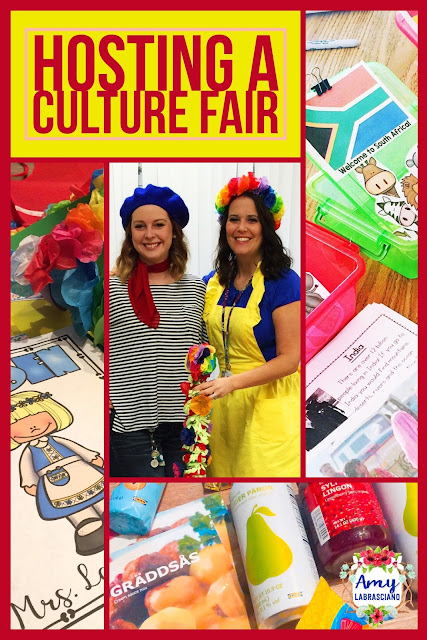
 We chose to hold the fair the day before Thanksgiving break.  The cultural fair was so engaging, the students were sure to learn all the way through the end of the day.  We weren't so sure that would happen with our every day lessons.  Each class prepared one of the more popular food or drinks from their country.  I bought prepackaged food from Ikea for my country.  This helps to satisfy the rule in some schools of prepackaged food.  The year before we had a parent make our food at home.  (I did not serve the pear drink.)

Click here to learn how to host a culture fair with your elementary students.  These fun ideas work for any primary or intermediate classroom.  You’ll be able to incorporate reading, writing and social studies together for a unit packed with fun.  Your kindergarten, first, second, third, fourth,  and fifth grade students will loves this activity.  {kindergarten, first, second, third, fourth, fifth grade, homeschool} #culturefair #culture

Each classroom can have a quick craft inside for the students to complete. We made floral headbands for Sweden.  Most countries have flowers in their culture so this is a wonderful go to craft.  If you search on Pinterest, you will find a plethora of cultural crafts.  We also used the folders that you see below to hold all of our research in reading and writing.

Click here to learn how to host a culture fair with your elementary students.  These fun ideas work for any primary or intermediate classroom.  You’ll be able to incorporate reading, writing and social studies together for a unit packed with fun.  Your kindergarten, first, second, third, fourth,  and fifth grade students will loves this activity.  {kindergarten, first, second, third, fourth, fifth grade, homeschool} #culturefair #culture


Every student was given a passport with the countries listed inside.  The students were to record details from every country that they visited.  So we allowed students to roam the hall.  They went into the rooms to enjoy food and a craft.  They read information on the countries outside of the rooms.  Their teachers held them accountable for details by checking their passports.  We had parent volunteers to come in to assist the students in moving throughout the hall and into the appropriate rooms.  If you can't do a whole grade level Culture Fair, you can set up centers in your classroom.  You can have groups of students research different countries and share with each other.

Click here to learn how to host a culture fair with your elementary students.  These fun ideas work for any primary or intermediate classroom.  You’ll be able to incorporate reading, writing and social studies together for a unit packed with fun.  Your kindergarten, first, second, third, fourth,  and fifth grade students will loves this activity.  {kindergarten, first, second, third, fourth, fifth grade, homeschool} #culturefair #culture


Putting together the materials for this unit took quite a while.  If you don't have time to put them together, check out the units below in my store.

Click here to learn how to host a culture fair with your elementary students.  These fun ideas work for any primary or intermediate classroom.  You’ll be able to incorporate reading, writing and social studies together for a unit packed with fun.  Your kindergarten, first, second, third, fourth,  and fifth grade students will loves this activity.  {kindergarten, first, second, third, fourth, fifth grade, homeschool} #culturefair #culture


Discriminating Teachers


Take a moment to look at this photo and reflect on your thoughts.


Be honest, did you stereotype or have negative feelings when you looked at it?  If you did, it’s o.k. Did you notice that we are a non-traditional family? It’s time that we open up and discuss racism and discrimination with one another without judgment. It's time that we grow and heal together.

Racism and discrimination is a problem that plagues the world.  I’ll be honest; I didn’t want to write this post.  I would much prefer to go about my day and ignore it.  That would be easiest for me, right?  Well, the issue with ignoring something is that it won’t go away.  You shouldn’t act on your prejudices because everyone is the same on the inside.  You should reflect on your thoughts and feelings and deal with them before they come out as racist or discriminatory actions.  The problem with me telling you this is no one wants to be told what to do or to think that they aren’t perfect, so no one will listen to this. 

Lets take a look at why you should be concerned with this topic.   Racism affects us all whether you think so or not.  Institutions are always implementing new rules and regulations to help end discrimination.  These changes affect us all in different work institutions.  As a teacher I have seen a couple of changes in the past few years.  One change is that we can’t staff minority children in contained ESE classes as readily as we used to.  This change came about because the number of minorities being staffed in ESE classes was disproportionate to other students.  We needed to impose strict rules because people were funneling the students that they didn't want to deal with in what they referred to as the "special" classes.  The result or problem that has come about for teachers and students is that we have minority students who need to be serviced outside of a mainstreamed classroom.  Some of these students suffer being in an environment that isn’t right for them.  Without staffing equality in place, we have no choice but to question the motives of people wanting to take minority students out of the mainstream classroom.  If this situation seems very confusing and not readily solved, it's because it is.  Another change that is very recent is writing office referrals for African American males.  In my state, the number of referrals that is being written for these males is disproportionate to their classmates.  Something needed to be done to protect these males from being unfairly judged.  So teachers have been told, don’t write write referrals for these males.  The problem for some of our African American males is that sometimes, just like their classmates, they need discipline and guidance to help them to be the best that they can be. If we don’t take a look inside of ourselves and at those around us, policies are going to get messy and make life much more complicated because we have no other choice but to impose rules to protect people being unfairly judged.  If we don’t change, institutions are forced to put practices into place to help right our wrongs.  It would benefit everyone to make sure that we reflect on our actions to make change.


How can we help end discrimination? We need to talk to one another and look at ourselves without judgement.  If we find that we have been hurtful with our words, discriminatory or have prejudices, it’s o.k. we just need to change our actions.  I’ll share a very personal example with you.  I have some very sweet friends that would do just about anything to help us out.  They would care for my children and speak kind and thoughtful words to them.  These same friends posted some very hurtful literature on Facebook about gay people.  What they don’t know is that my mother is a lesbian.  These words that they post are very hurtful to me, but I’m used to seeing these words so I ignore them and go about my day.  I know that these friends are good people and wouldn’t speak these unkind words to my children because it would hurt my children to have someone speak of their grandmas this way.  They would never look at my family; my mother included, and spew the hateful message that they posted. They will probably be shocked to see that lesbians can raise women to be very productive members of society.  Their thought process is that they will all raise sinful gay children who are a plight on society.  Well here I am world, I have a master’s degree, I’ve been with my husband for 20 years, I have 3 beautiful children, I pay my taxes and I’ve never been to jail.  They have been taught these prejudices throughout their lives just like we have all been taught something wrong throughout our lives.  Come together and open up the dialog.  Share your dialog with Tanesha, Amna and myself in our comments section.  Reflect on all of our stories.  Let’s make a change.

Link to our blog series with the buttons below.



Back To School


School supplies are selling out in stores across America.  This can only mean one thing - it's time to go back to school.  <insert wailing teachers here> We want to make the summer to fall transition as easy as possible for you so we have 10 bundles of everything included below to give away.


Fern's coloring pack would be great for introducing school staff, meet the teacher night and bell work.  It's important to keep the kids engaged and learning while you attend to parents and incoming students.
The Inspired Owl's Corner is offering an Owl themed or Brightly themed decor set.  I personally use these sets in my class.  They are amazing!!!


Easy Teaching Tool's  is going to make your parent communication a breeze with her back to school pamphlet.  It's a great way to let the parents know what to expect and to ease their worries.


Learning Is Something To Treasure is going out of her way to make your whole year a breeze.  She's giving away mega pack of phonics sorts!!!


A First For Everything has all of your close reading needs for the fall right here in this pack.  Start the students off on the right foot.


Pawsitively Teaching knows how to develop a classroom culture of respect and learning.  She wants to help you do the same thing with her classroom management bundle.

Amy is giving away a Jan Brett pack with lessons and activities for 10 of Jan's books.  Everyone loves to display cute student work.  It's a great way to make admin. happy and the kids ecstatic.

Cassie has everything you will need for sight word centers.  This is a must have for every primary classroom.

We wish you lots of luck in the raffle.  Be sure to check out each person's link to see if they have any other fun give aways going on.


Working Smarter Not Harder in the Classroom


Sometimes working harder in the classroom doesn't make us a better teacher. Over the years I've had some awesome ideas that teach students the content perfectly and look great. Well at least I thought they were awesome ideas then.  Now I know they were time consuming and energy draining.  When I design my classroom now my first thought is:  Will it help  the students throughout the year?  Then I move onto:  Is it visually distracting for students?  Here are a few tips.


Word walls are an essential part of elementary classrooms.  We have a few up in our classroom.  For sight words and frequently used words we sectioned off our white board.  We can add and delete words easily as the students need them.  We chose not to use cards because we go through hundreds a year and filing them is too time consuming.


Our math and science vocabulary words are written on index cards and then stored in library pockets.  We display them in small pocket charts from the Target Dollar Spot.  This allows us to organize as we go.  There aren't nearly as many terms as our sight words so writing them is easy.  We save these cards for each unit and use them again the next year.


Having a million anchor charts around the room is distracting.  We have all of our core areas on interchangeable clothes pins.  This way we can clip it up, take it down and store it as needed.  The clothes pins are hot glued so that they can store about five charts at a time.  It gives the room a clean appearance, helps the student's brains to rest and serves as an anchor for students when needed.  Above the writing anchor I have our morning work examples.  We allow students to come into class 30 minutes early each day.  The students trickle in throughout this period.  In order to save copies and make learning meaningful, I put up four writing centers (from Mel. D. at Seusstastic)  a week.  The kids get to choose which one they want, grab their copy from a drawer and work on it as time allows before school.  This saves us from making copies for every child every morning.


Does your roster change a lot at your school? We always lose and gain at least one different name.  Instead of making a fancy chart that I have to change out I like to print them individually.  This way I can just change out one as needed.  (These printables came from the Inspired Owl's Corner.)


I LOVE personalized student work areas, but it makes it difficult and time consuming when we lose and gain students.  A nice general area where work can be put up and taken down quickly gives the same sense of pride to students, but makes the task of putting it up pretty simple for us!

If you have any ideas on working smarter not harder in the classroom I would love for you to leave your ideas in the comments below.

Citizenship


Citizenship is such a fun topic to teach students.  Watching the light bulb go off when they learn that they are here to serve the world is inspiring.  So where should we start when teaching citizenship?

Some key points to teach while addressing citizenship include:
What makes us a citizen?
Rules and Laws
Rights and Responsibilities
Contributions to Community

Lessons are so much better when you add in a hook that engages children.  We always like to start this unit off with an explanation of why we need to be a good citizen.  This includes contributions to our community.  Consider using Kid President to explain the hows and whys of contributing to our community.  I've included a video link for you below.


These books are a good place to start if you need material to read to your students for citizenship.

Every teaching unit needs engaging activities that present students with a hands-on learning experience.  A great example of an engaging educator is Debbie Clement.   I've compiled a pinterest board with a creative project from her and some other suggestions for you.


Time is always an issue in the classroom for me.  Due to this, I created materials that I could use quickly and efficiently. If you are in need of any more materials check out my unit.


Take care!

Must Have Social Studies Books for 2nd and 3rd Grade


One of the largest problems that I have to solve each year in my classroom is how to teach social studies.  We are given very  little resources for social studies and no time in our schedule!!!! How about you? Last year I decided to really focus on how to integrate social studies into our day, teach the students the best lessons available and appease the powers that be as best I could.  The first task was to find books that I could build a social studies library with.  While I can't afford every book in this post, I tried to focus on a few key ones and check the rest out from the library when needed.

 If one can be addicted to books then I'm certainly addicted to True Books.  They are perfect for 2nd and 3rd grade.  The students are drawn to the vivid photographs making them a hit for everyone.  I purchased one from every native American region for my students to read.  If you are interested, try to purchase them used on Amazon.  Prime members get some used books shipped for free.  Each book ran around $4 with library binding. That's right library binding.  They are sure to last a long time.  Most of them look brand new.  If they didn't look brand new they had just a bit of wear.  Only having one book for students is an issue.  To overcome this we split the class into groups and have each one study a tribe.  We then came together and debrief with classroom conversation and show projects that we have worked on.


Samuel Eaton and Sarah Morton are always a hit with students.  The vivid photographs capture their attention.  "The Thirteen Colonies"s is a great book, but not as captivating as Samuel and Sarah. I haven't  purchased "Land of the Pilgrims' Pride" with Ellis the elephant, but it's next on my list.  If you have it would you please leave a comment on how you like it?


"The Name Jar" and "Grandfather's Journey" are both great books that tell stories of immigration.  I have a feeling I'll be collecting the entire collection of Ellis the Elephant books this year.


"How to Behave and Why" is a fabulous book that explains why we follow rules.  It's not fancy, but it does a great job of explaining the content.  The biography books by Meltzer do a nice job of showing contributions by exceptional citizens.  There is a whole series so you could pick one near and dear to you.


Finding the perfect book on economics for children is an arduous task!!!! The books on the bottom row have the exact content to teach students.  They are written on a lower level, but sometimes it's nice to have a quick read that does the job.


Have you found a book on mapping that you can't live without?  This is a tough subject to write on.  I used "Mapping Penny's World" and "Follow That Map!" last year.  They got the job done.


If I had to have one book with symbols, "America" is a good one.  It has a lot of nice illustrations that show symbols.


It's hard to suggest culture books when there are so many. I try to focus on informational text that engages students and explains the basics of the culture.  We didn't have enough time in our school year to study a meaningful amount of cultures last year so we came up with a plan.  My grade level held a culture fair.  Each class studied a different country.  The students then got to rotate through the classes to learn about different ones.  It was a great way to increase learning and engagement within a short time span.

Aside from finding books to use I also had to write lessons that ran about 20 minutes each.  We needed to have materials that were hands-on, engaging and explicit.  I worked all year to develop lesson suggestions and materials that fit my student's needs and helped them to master the content.  If you don't have time to do this, you can click on the link below to visit my store and materials.